
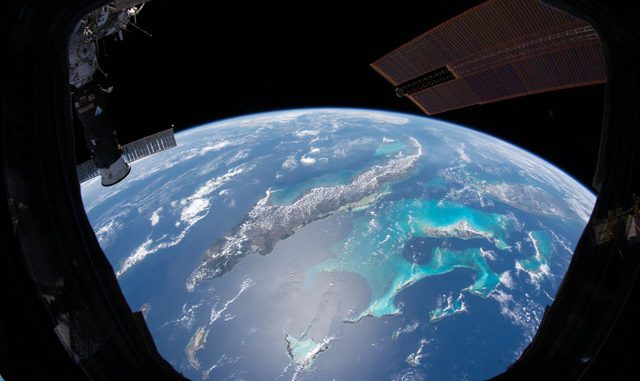
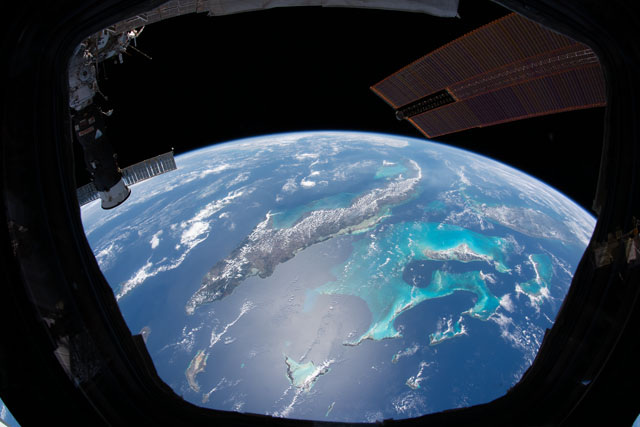
This is what Cuba and the Caribbean Sea looks like from the Cupola of the International Space Station, as photographed on March 30, 2020.
From the description of the image in NASA’s Gateway to Astronaut Photography of Earth:
Clouds trace out the islands of the Caribbean Sea in this photo taken by an astronaut from inside the Cupola on the International Space Station. Beyond the solar arrays and the docked Progress resupply vehicle, the multi-toned waters of the Caribbean and the Atlantic Ocean frame the Bahamas, Cuba, Jamaica, and southern Florida.
The bright turquoise water around the Bahamas contrasts sharply with the darker blues of the open ocean. From above, the contrast allows us to see the Tongue of the Ocean, a submarine canyon descending nearly 4300 meters (14,000 feet) below the surrounding shallow bank. The variable water colors can be explained by the underwater topography and water depth (bathymetry) and how it leads to varying light absorption and reflection. In the clear and shallow waters of the Caribbean, more sunlight reflects off the sand and reef surfaces, causing the water to appear lighter in color. The shallow water that surrounds the Bahamas and outlines the Tongue of the Ocean comprise the Great and Little Bahama Banks.
This photo was captured on a peaceful, if somewhat cloudy, spring day. But in the summertime, this region is known colloquially as “hurricane alley”. Tropical cyclones that form off the coast of Africa and mature in warm Atlantic waters frequently first encounter land at these islands. Unfortunately for residents, the number of named storms in the Atlantic has been increasing in recent years.
Leave a Reply
You must be logged in to post a comment.