
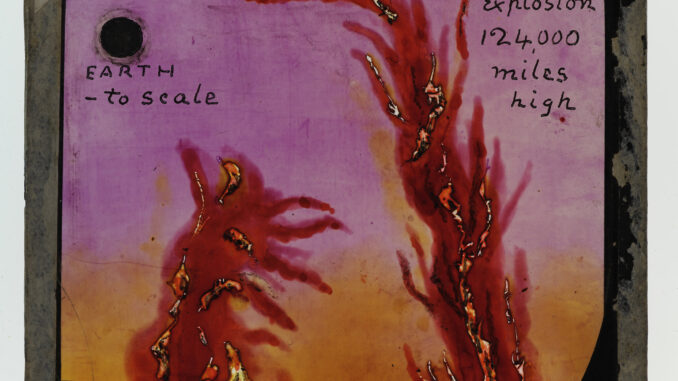
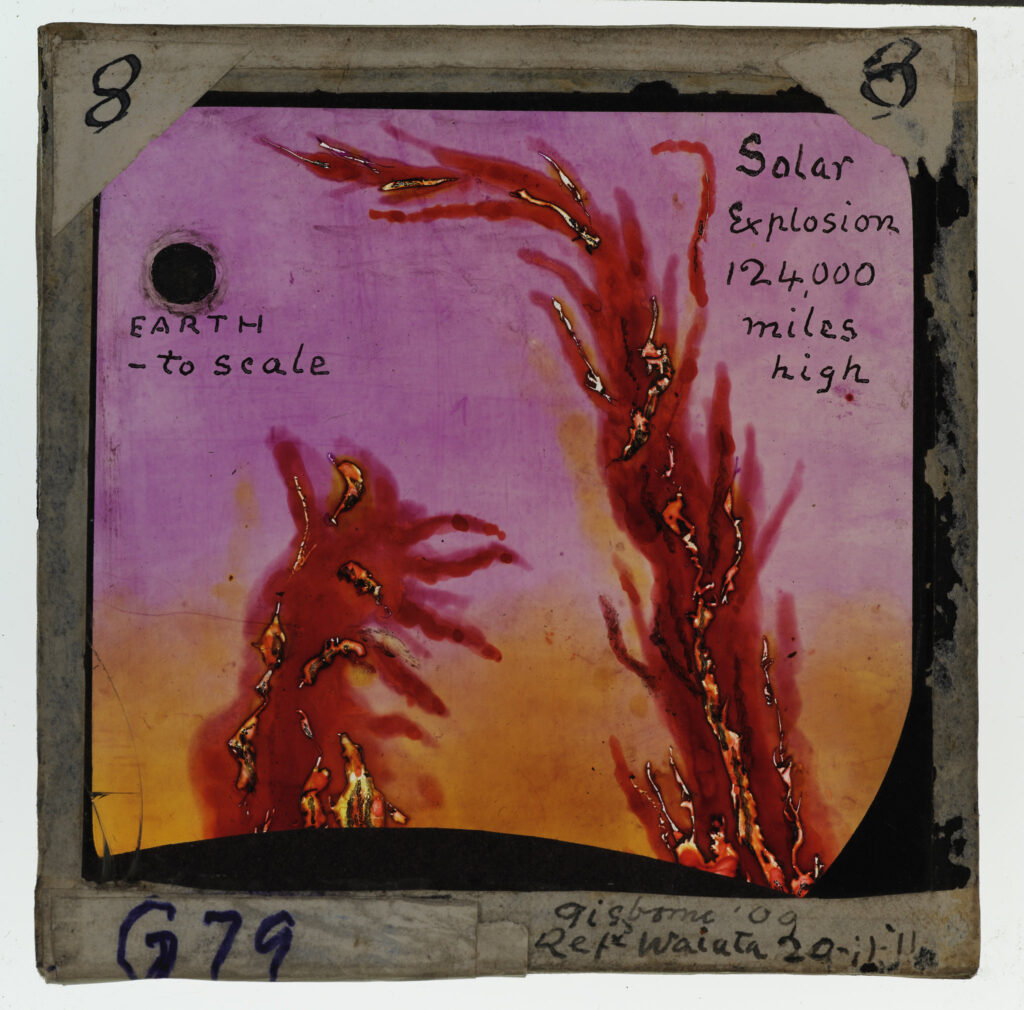
This is a slide from the magic lantern shows of Clement Lindley Wragge, a popularizer of astronomy, a meteorologist, and a Theosophist mystic who died in 1922.
There’s a collection of his work up at Public Domain Review, including dramatic paintings of the moon’s craters, sunspots, and the planet Saturn as seen from one its moons … all done before the age of rocketry had taken cameras outside the atmosphere and back home again. These are interspersed with slides of flowers, flocks of sheep, and words asking us, the audience, about the nature of knowledge and our place in the universe. Prior to his mystical turn, he set up weather observatories in Scotland, Australia, and New Zealand.
He also tried doing things with the weather:
His most famous exploit, however, was a failure. Having purchased a battery of Steiger Vortex canons, which had been invented to prevent hail from forming over vineyards in Europe, Wragge installed six in Charleville, Queensland, and proclaimed that he would end the drought of 1902. His solution? Fire these cannon-like devices at clouds and watch as the acoustic shockwaves produced by their gas explosions resulted in rain. While the first firing was met with a bit of drizzle, the second barrage produced no precipitation and two of the cannons exploded. When later interviewed about the flop, Wragge blamed his civilian assistants: “the people of Charleville did not carry out the experiment properly”, he said. “They only fired ten shots, whereas they should have continued firing for ten minutes, at the rate of two shots a minute from each gun.”
This same image was shared on Flickr by the Auckland War Memorial Museum, Tāmaki Paenga Hira, as part of the Clement Lindley Wragge collection. They added the following description:
The slide shows a pink/orange tinted plate depicting two swirling columnar forms with burnt details representing solar explosions 124,000 miles high, a small dark circle in the upper left corner of the plate represents Earth to scale.
…and added that there’s a note on the back that says, “After Larkin.” Not sure if that means inspired by an illustration by an artist named Larkin, or if this slide was sequenced in the slide show after a slide about Larkin. Probably the former, but you never know….
It’s certainly a dramatic image.