
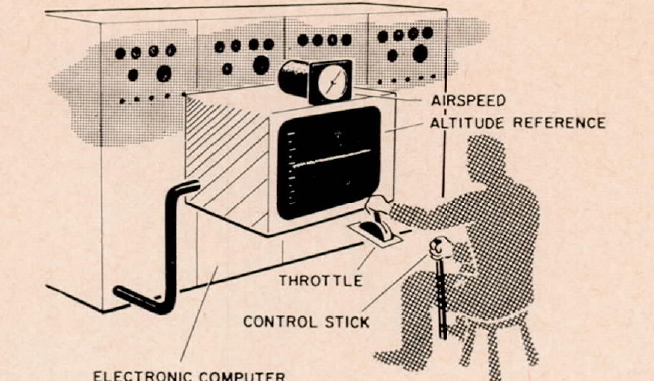
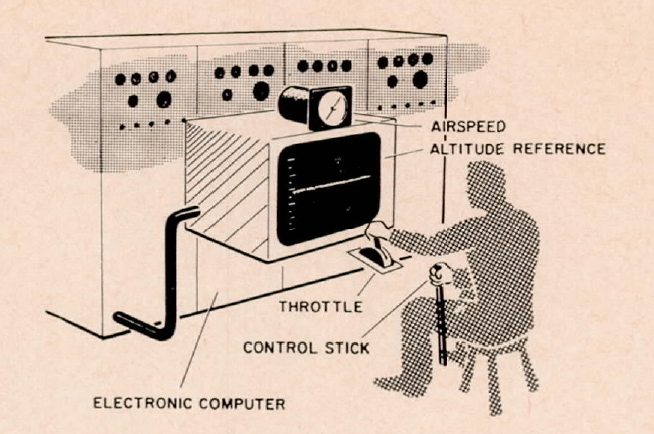
This is Figure 3 from “Man-Machine System Simulation for Flight Vehicles” by Steven Belsley, an article which was published in a journal called (deep breath) IEEE Transactions of the Technical Professional Group on Human Factors in Electronics (which seems to be a fancy way of saying “Humans Using Machines”), Vol HFE-4, No. 1, September 1963 but I found it on the NASA Technical Report Server,
It’s a student pilot in front of a screen showing them how to fly without burning the fuel and taking the risks of getting in a plane and taking off. The screen in question is not a television screen showing video. It’s an oscilloscope, showing altitude (as one horizontal line, being displaced vertically as the plane rises and descends) and vertical acceleration (as a shorter horizontal line, moving vertically on the screen). This rather indirect way of mimicking a plane in flight was used to study “the minimum
comfortable approach speeds for carrier-type landings.” They also had fancier simulators that looked like a genuine control panel with all the real gauges and whatnot, and even a “five-degree-of-freedom motion simulator” that is a sort of miniature cockpit mounted on a swivel at the end of a crane arm rigged to spin in a circle.
Which sounds like a very unpleasant carnival ride. Part of what was being tested here was how well people reacted to the machines, how much the test pilots could learn from (and react to) the situations that the simulators were, well, simulating. One of the upshots of the experiments was that it would be a good idea to develop different simulators for different things being tested: airspeed changes, hovering aircraft, different missions, and so on.