
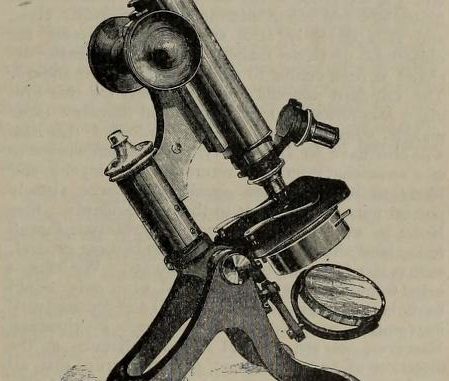
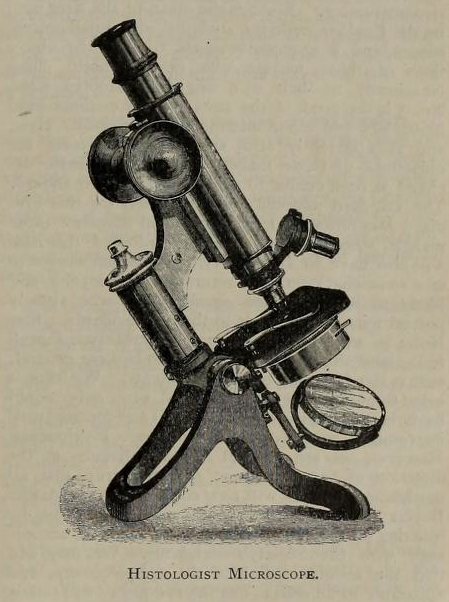
An illustration of an elegant optical device from Science Gossip magazine (a publication which I discovered via Nemfrog).
It’s described by the editors thusly:
Crouch’s “Histologist”” Microscope. — Mr. Henry Crouch, of 92 Duncombe Road, London, N., has submitted for our examination the latest model of his “Histologist” microscope, which is specially designed for the use of students, particularly medical students. We give an illustration of the instrument. The coarse adjustment is by the now customary diagonal rack and pinion, and the fine adjustment is of the micrometer screw type. The foot is a claw tripod, and as such is perfectly steady. The stage is of the horseshoe pattern, but in the microscope submitted to us the advantage of this was somewhat discounted by the sub-stage ring being fixed in position beneath the stage. The microscope itself is well made and finished, and is specially designed to withstand the rough wear and tear of a laboratory. There are the usual plane and concave mirrors. The objectives generally supplied are the 2/3-inch, N.A. °28, and 1/6-inch, N.A. °65, both being arranged to work approximately in the same focal plane. The apertures are moderate, as is suitable for histological work ; but the objectives are excellent ones, and will bear favourable comparison with any others in the market at the same price. The price of the 2/3-inch is 15s. and of the 1.6-inch 30s. We had also an opportunity of examining a 1-inch N.A. °26 at 15s., and a 1/12-inch oil immersion N.A. 1°3 at £5. This last was a really fine lens. The microscope, as described above, with double nosepiece, 2/3 and 1/6 inch objectives, two eye-pieces, and mahogany case, is sold at £7 7s., or with Abbé condenser N.A, 1°2, with iris diaphragm, 30s. extra.
“Histology,” if you’re curious, is the counterpart of gross anatomy that requires a microscope. In other words, the anatomy of cells and tissues and the little structures of living things. It’s interesting that this microscope looks a little bit like it grew that way.