
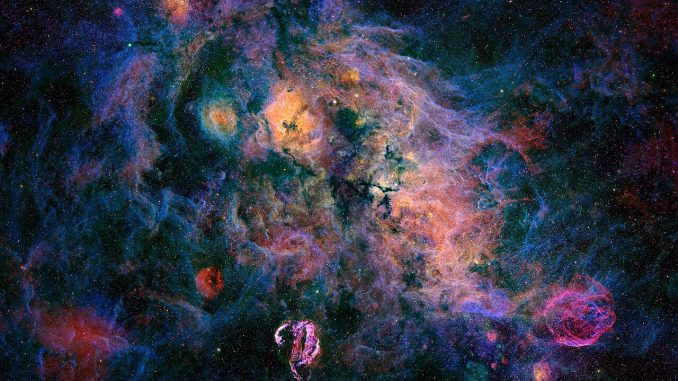
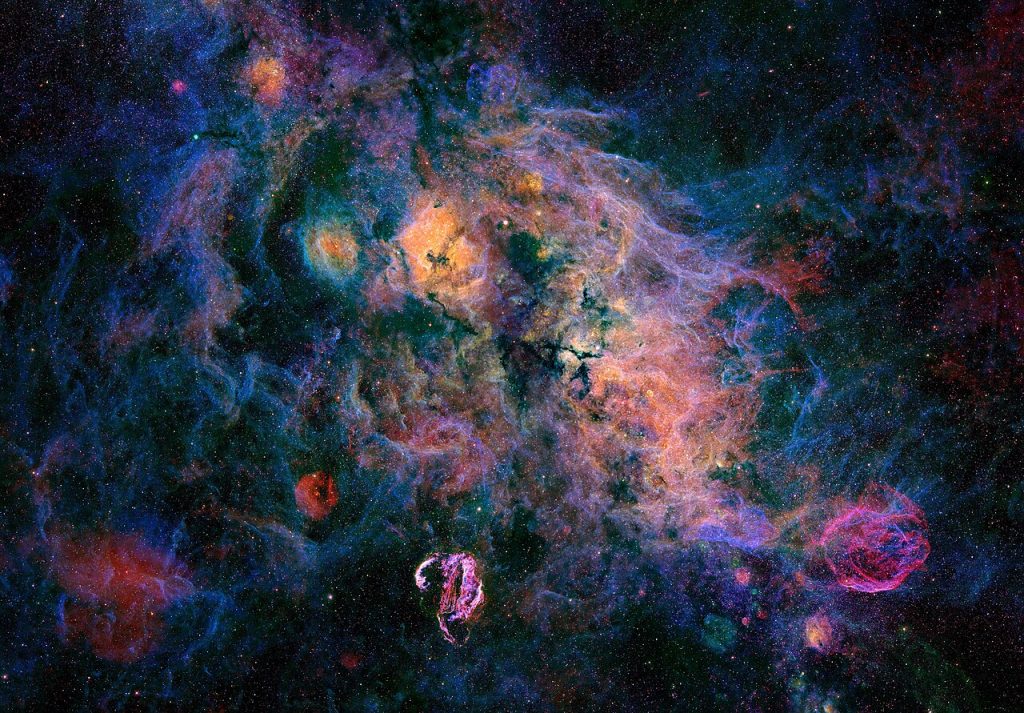
This is a photo of space with a bit of color amplification so we can tell what we’re looking at. Nebulas on their own aren’t quite this exciting.
In more detail, from the Wikimedia Commons page where I found it:
Numerous emission nebulae in the constellation Cygnus seen by the Northern Sky Narrowband Survey. In this false color image, doubly ionized oxygen ([OIII] at 500.7 nm) is mapped to red, ionized hydrogen (Hα at 656.3 nm) is mapped to green and singly ionized sulfur ([SII] at 671.7 nm and 673.0 nm) is mapped to blue. The brightest stars are added to visualize the regions contaminated by strong continuum light. (Aside from that, the image does not contain continuum light.)
The field of view is 40° × 28°. Equatorial center coordinates are RA=20h40m and DEC=40°. North is up.The yellow regions are HII regions ionized by young stars recently formed within giant molecular clouds. Most of the bluish and reddish filaments spreading across the image are supernova remnants.
User Tk833 (that is, the Northern Sky Narrowband Survey) can be proud of making this Featured Picture, which will be highlighted as the site’s Picture of the Day for 31 July 2027, when and if we get there.
I mean, if anything, this picture does show that some stars just blow up….