
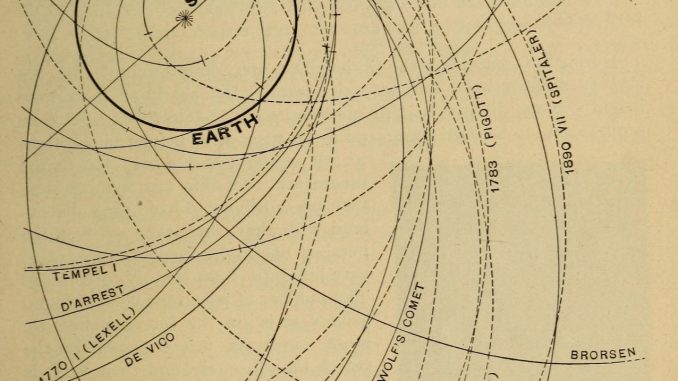
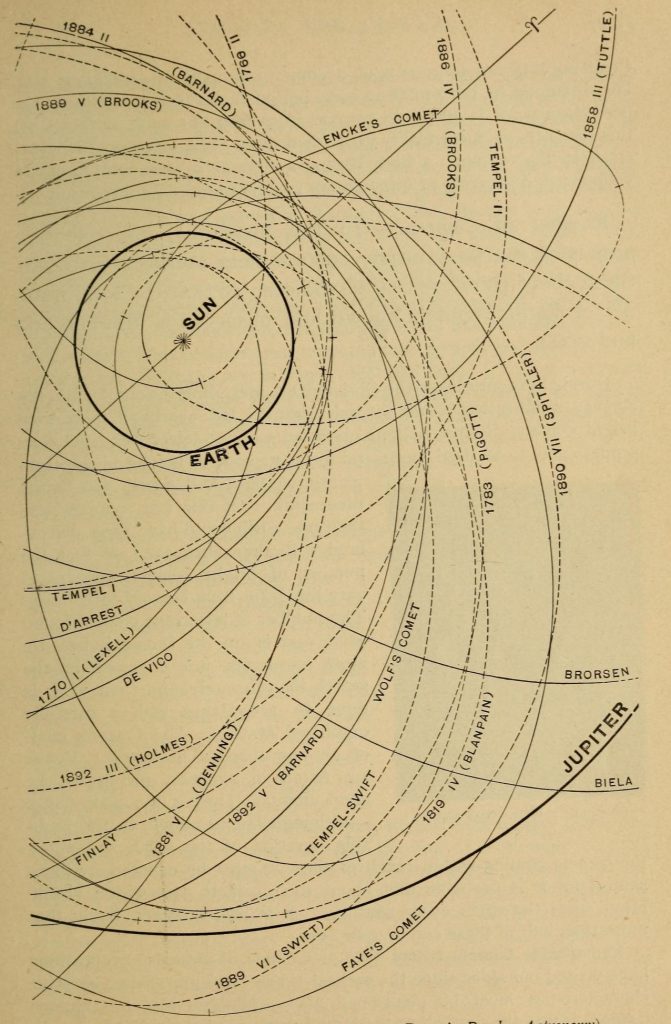
This is a diagram from A New Astronomy For Beginners, a textbook that’s about a century and a quarter old, or a little more. It’s filled with language like, “Comets of immense proportions have visited our skies since the earliest times. Others having singular characteristics must be mentioned also.” … and …
In 1882 there were two bright comets, one of them in many respects extraordinary. So great was the intrinsic brightness that it was observed with the naked eye, close alongside the sun. Indeed, it passed between the earth and the sun, in actual transit ; and just before entering upon the disk, the intrinsic brightness of the nucleus was seen to be scarcely inferior to that of the sun itself. It was a comet of huge proportions. Its tail stretched through space over a distance exceeding that of the sun from the earth, and parts of its head passed within 300,000 miles of the solar surface, at a speed of 200 miles a second. Probably this near approach explains what was seen to take place on recession from the sun — the breaking up of the comet’s head into several separate nuclear masses, each pursuing an independent path. Also this comet’s tail presented a variety of unusual phenomena, at one time being single and nearly straight, while again there were two tails slightly curved. Besides this, its coma was surrounded by an enormous sheath or envelope several million miles long, extending toward the sun.
I found this image and this book on archive.org.