
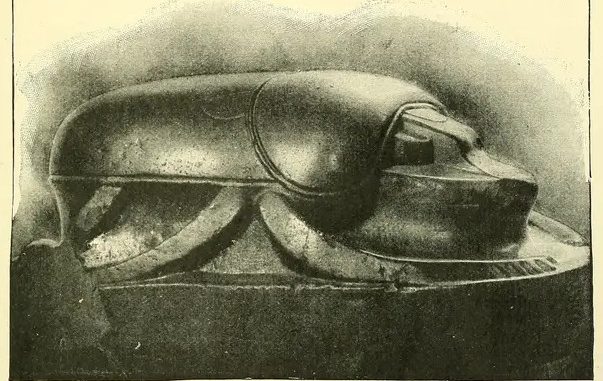
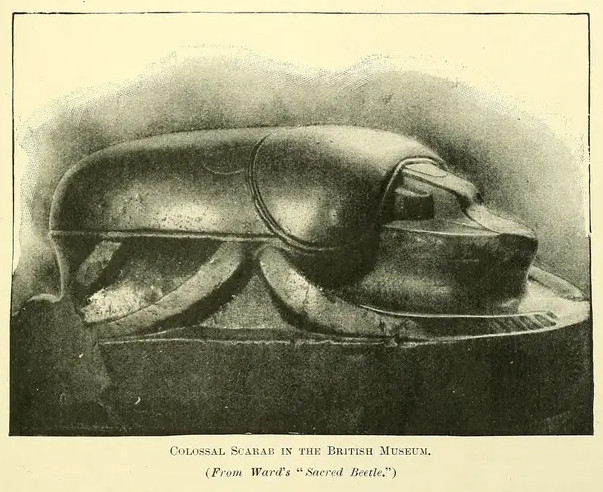
This is maybe one of the oldest scientific illustrations to have been entered here, depending on how you want to qualify such things. The photo is from 1901, and was published as part of a review of John Ward’s The Sacred Beetle, one of several book reviews in this issue of Science Gossip found in the Biodiversity Heritage Library. It appears after a review of a new, “cheap but not in any way nasty” edition of Charles Darwin’s The Origin of Species. Ward’s book is partially art history, partially archaeology, and maybe a little bit of entomology.
The statue is also somewhere between art, religion, and biology. From the review:
As the author points out in his introductory pages, every educated person is supposed to know
“what is a scarab.” This is, however, by no means the case, and this popular work upon the Egyptian scarabs in art and history is welcome. They are carved imitations in stone of dung-beetles. These sacred or historical records of a very early civilisation are of the highest interest and value to students of far-away bygone times. Probably used in the earliest periods as amulets, they eventually became sacred emblems, appertaining to the monarchs as heads of the Church in Egypt.
I like that the image is two kinds of old; the oldness from being more than a century old, faded paper and irised black-and-white photographs, and the oldness from being millennia old, smooth stone cut into geometrical likenesses of recognizable creatures. The individual beetles from either era are long dead, but the form of the beetle remains. It’s a good shape, one that lasts.
Leave a Reply
You must be logged in to post a comment.