The Guild of Scientific Troubadours

The Guild of Scientific Troubadours

ex scientia, sono

  • Home
  • Join the Guild
  • The Scientific Troubadour Pledge
  • The SONGS

botany

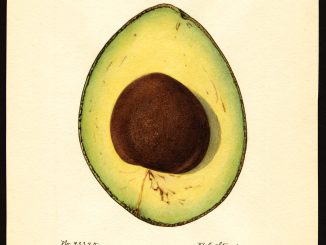
Scientific Illustration of a Taft avocado, from the USDA Pomological Watercolors

Science Art: Persea: Taft, by Royal Charles Steadman, 1914.

7 March 2021 grant 0

Scientific Illustration of a Taft avocado, from the USDA Pomological Watercolors Click to embiggen

It’s an avocado, an aguacate, also known as an alligator pear in English and a “lawyer pear” in Dutch. This is a Taft variety, an ancestor of the Lula … Read the rest “Science Art: Persea: Taft, by Royal Charles Steadman, 1914.”

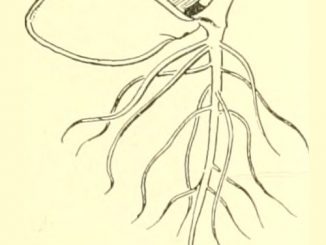
Scientific illustration of a seed sprouting.

Science Art: Germinating squash seed, 1908

8 November 2020 grant 0

Scientific illustration of a seed sprouting.

A new beginning, from Elements of Philippine Agriculture on archive.org (though I found it on Flickr Commons).

Scientific Illustration of peas and musk melon, from an 1899 seed catalog

Science Art: Gradus Peas, Petoskey or Paul Rose Musk Melon, 1899

3 May 2020 grant 0

Scientific Illustration of peas and musk melon, from an 1899 seed catalogClick to embiggen

From the D.M. Ferry & Co. Seed Annual, via the Biodiversity Heritage Library.

Fresh vegetables, fresh muskmelon. Mmm. I do love a muskmelon.

Yes, indigenous South Americans were actively managing the forest.

11 March 2020 grant 0

Scientific American looks at old trees to determine how so-called hunter-gatherers were actually actively “farming” the Brazil nuts and cocoa trees they relied on for food… Read the rest “Yes, indigenous South Americans were actively managing the forest.”

Scientific illustration of a puffball, sweetbread, horn of plenty and chanterelle mushroom, from Edible and poisonous mushrooms:. London,Society for Promoting Christian Knowledge,1894..

Science Art: Plate 7: Sweetbread, Horn of Plenty, Puffball, Chanterelle, from Edible and Poisonous Mushrooms, 1894.

2 February 2020 grant 0

Scientific illustration of a puffball, sweetbread, horn of plenty and chanterelle mushroom, from Edible and poisonous mushrooms:. London,Society for Promoting Christian Knowledge,1894.Click to embiggen vastly.

Mushrooms you can trust. I think.

From the Biodiversity Heritage Library’s Flickr collection “Edible and poisonous mushrooms: what to eat and … Read the rest “Science Art: Plate 7: Sweetbread, Horn of Plenty, Puffball, Chanterelle, from Edible and Poisonous Mushrooms, 1894.”

Scientific illustration of desmids (algae)

Science Art: Plate XIV (Cosmarium species from Desmids of the United States….

12 May 2019 grant 0

Scientific illustration of desmids (algae)

Single-celled algae, magnified 500 times.

They float in ponds and stream banks. I found them in the Biodiversity Heritage Library, in the Rev. Francis Wolle’s 1884 book Desmids … Read the rest “Science Art: Plate XIV (Cosmarium species from Desmids of the United States….”

dead horse arum lily

Science Art: Helicodiceros crinitus Schott by J. Strohmayer / Anstalt v. Reiffenstein & Rösch in Wein.

8 January 2019 grant 0

Click to embiggen
An image of an arum, from the Biodiversity Heritage Library’s Aroideae, 1 album, consisting of plates from Heinrich Wilhelm Schott’s Aroideae. The artist… Read the rest “Science Art: Helicodiceros crinitus Schott by J. Strohmayer / Anstalt v. Reiffenstein & Rösch in Wein.”

Genetically-altered houseplants clear indoor air.

31 December 2018 grant 0

Science Daily reveals an environmentally friendly GMO – a new variety of pothos ivy that University of Washington researchers designed to remove chloroform and benzene from the… Read the rest “Genetically-altered houseplants clear indoor air.”

SONG: Upside Down

6 July 2018 grant 0

SONG: “Upside Down”.

ARTIST: grant.

SOURCE: Nature, 12 June 2018, “Africa’s majestic baobab trees are mysteriously dying”, as used in the post “The … Read the rest “SONG: Upside Down”

The baobabs are dying.

14 June 2018 grant 0

No, this isn’t a heart-wrenching sequel to The Little Prince. It’s a report in Nature on a baffling illness striking down some of Africa’s most distinctive trees:

In

… Read the rest “The baobabs are dying.”

Science Art: Tab X from Ueber den Pollen by Carl Julius Fritzsche, 1837.

6 May 2018 grant 0

From Pollen Up Close: http://publicdomainreview.org/collections/pollen-up-close-1837/

Where plants come from. (And hay fever.) These are as seen through a pretty powerful microscope – magnified 500 times – and drawn by a German pharmacist and chemist living in… Read the rest “Science Art: Tab X from Ueber den Pollen by Carl Julius Fritzsche, 1837.”

Sigh. Maybe a sweet potato *doesn’t* mean that prehistoric Polynesians visited South America after all.

18 April 2018 grant 0

The Guardian has some sweet potato evolutionary research that unintentionally drives a wedge in the idea that the presence of the humble yam in both places indicates that prehistoric Polynesian… Read the rest “Sigh. Maybe a sweet potato *doesn’t* mean that prehistoric Polynesians visited South America after all.”

Science Art: De XII Afbeelding (Banana) by Maria Sibylla Merian

26 November 2017 grant 0

from  https://www.biodiversitylibrary.org/item/129308#page/45/mode/1up Click to embiggen

At the end of the 17th century, this was some weird and wild stuff – a fruit that in the Americas, they call “banana” (if I’m reading the Dutch text… Read the rest “Science Art: De XII Afbeelding (Banana) by Maria Sibylla Merian”

Tomato plants can defend themselves – by turning caterpillars into cannibals.

12 July 2017 grant 0

Nature is decidedly unappetizing in its discussion of how vegetables turn attackers against each other:

Integrative biologist John Orrock and his colleagues at the University of Wisconsin

… Read the rest “Tomato plants can defend themselves – by turning caterpillars into cannibals.”

Very old oak; pretty young genes.

20 June 2017 grant 0

Nature examines a tree that was alive in the time of Napoleon, yet has DNA that’s remarkably free of the usual damage of aging:

Each time a cell divides, mutations can arise because

… Read the rest “Very old oak; pretty young genes.”

Posts pagination

« 1 2 3 … 6 »

Follow on Bandcamp

Something to Believe In

GRANT: something to believe in

You could write a review of this album here on iTunes.

That would be generous.

Fellow Travelers

  • 314.Action
  • Bioephemera
  • Breakfast in the Ruins
  • Carabus
  • Discover
  • Fluxblog
  • Giant-Killer
  • grant (archive)
  • grant (bandcamp)
  • Hello, Poindexter!
  • ideonexus
  • junior kitchen
  • Keep Your Pebbles
  • LiveScience
  • Mindless Ones
  • Nature
  • New Scientist
  • NIMBioS: Science Songwriters-in-Residence
  • Peculiar Velocity
  • PhysOrg
  • Science Daily
  • Science Magazine
  • Science News
  • Science Writers Daily
  • Scientific American
  • Singing Science Records
  • Songfight!
  • Space.com
  • Stereo Sanctity
  • The Great Beyond
  • The Other Adam Ford
  • The Periodic Table of Poetry
  • Voyages Extraordinaires

Tags

acoustics aeronautics agronomy anatomy anthropology archaeology astronomy biochemistry biology botany chemistry climatology computer science ecology economics electrical engineering electronics engineering entomology epidemiology evolution genetics geology linguistics marine biology mathematics medicine meteorology microbiology microscopy nanotechnology neurology oceanography optics paleontology pharmacology physics psychology quantum physics research robotics sociology space exploration theremin zoology
RSS Help Wanted: ScienceCareers
  • Ellison Institute of Technology: Bioinformatician
  • American Academy of Arts and Sciences - Hellman Fellowship: Civic Science Fellow in Science, Engineering, and Technology
  • Faculté de biologie et de médecine de Lausanne: Associate Professor in the field of exercise and environmental physiology
  • City University of Hong Kong (Dongguan) - Faculty: Chair Professors, Professors, Associate Professors, Assistant Professors, and Assistant Professors
  • St. Anna Children´s Cancer Research Institute: Principal Investigator (f/m/d) - Translational Medicine for Pediatric Cancer
  • St. Anna Children´s Cancer Research Institute: Principal Investigator (f/m/d) – Innovative Zebrafish Models for Pediatric Cancer
Honorary Troubadours
  • Jonathan Coulton, Contributing Troubadour for Popular Science.
  • Laura Veirs, who knows her way around a polysyllable.
  • Thomas Dolby, godfather of scientific pop.
  • Squeaky, fact-based rock about fusion containment & rocket science.
  • Cosmos II, a.k.a. Boston University astronomer Alan Marscher.
  • Dr. Fiorella Terenzi, astrophysicist who makes music from cosmic radio sources.
  • Dr. Jim Webb, astronomy professor and acoustic guitarist.
  • Artichoke, the band behind 26 Scientists, Vols. I and II.
  • They Might Be Giants, unrelenting proponents of scientific popular song.
  • Symphonies of Science, the people who make Carl Sagan and others sing.
  • Giant Squid, doom metal about the sublime horrors of marine biology.
  • Gethan Dick,6 scientists, 6 musicians, 1 great album
Related Projects
  • Squid Pro Crow
  • Grant Bandcamp
  • Grant Soundcloud
  • Penitential Originals Playlist
https://guildofscientifictroubadours.com/wp-content/uploads/2009/04/01-gravity-song.mp3

 
"Is it a fact—or have I dreamt it—that, by means of electricity, the world of matter has become a great nerve, vibrating thousands of miles in a breathless point of time?"
— Nathaniel Hawthorne, The House of the Seven Gables, 1851

grant balfour made this website.

Member institution: Duct Tape Aesthetic Laboratories
Tools
  • Subscribe via Email
     
  • View as PDF (via FiveFingers)
     
  • Is Facebook Electric?
     
  •   Yes, yes, we RSS!

     
Fields of Inquiry
  • Cold Storage
  • Featured
  • Guild Affairs
  • Music
    • Songs
      • Penitential Covers
  • Science
    • Science Art

Copyright © 2026 | WordPress Theme by MH Themes

Social Media Auto Publish Powered By : XYZScripts.com