The Guild of Scientific Troubadours

The Guild of Scientific Troubadours

ex scientia, sono

  • Home
  • Join the Guild
  • The Scientific Troubadour Pledge
  • The SONGS

marine biology

Light-loving algae survive, trapped under dark Arctic ice.

6 October 2020 grant 0

Science News plunges into the dark, icy depths to discover how it is that phytoplankton, which convert sunlight to energy, survive and even thrive under the ice in the long, lightless Arctic… Read the rest “Light-loving algae survive, trapped under dark Arctic ice.”

Can you hold your breath for more than 3 1/2 hours? This guy can.

28 September 2020 grant 0

Science News reports on a new record – three hours and 42 minutes underwater without coming up for air – set by a Cuvier’s beaked whale:

Cuvier’s beaked whales (Ziphius

… Read the rest “Can you hold your breath for more than 3 1/2 hours? This guy can.”

SONG: All I See

24 August 2020 grant 0

SONG: “All I See”

ARTIST: grant.

SOURCE: Based on Scientific American, 28 July 2020, “The Brittle Star That Sees with Its Body”, as used in the post ”
A brittle
… Read the rest “SONG: All I See”

A brittle star’s whole body is an eye.

28 July 2020 grant 0

Scientific American looks at how these starfish relatives don’t need eyes to see:

And yet now there appears to be something far stranger about the biology of at least one species:

… Read the rest “A brittle star’s whole body is an eye.”
Scientific illustration of a tardigrade from Bermuda.

Science Art: Florarctus antillensis Van Der Land 1968, from “Tardigrades marins des Bermudes,” 1970

28 June 2020 grant 0

Click to embiggen

A water bear from Bermuda, as published in 1970 (a good time to be in Bermuda). Florarctus antillensis was apparently first discovered in the coral sands of Curacao, also… Read the rest “Science Art: Florarctus antillensis Van Der Land 1968, from “Tardigrades marins des Bermudes,” 1970”

These sea worms look sequined – so we named them after Elvis

28 May 2020 grant 0

Science News reviews the show-stopping submarine research that has gone behind the scenes with four species of sequined sea worms that have collectively been named “Elvis worms”… Read the rest “These sea worms look sequined – so we named them after Elvis”

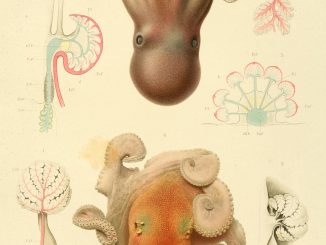
Scientific illustration of octopuses from an expedition by Prince Albert I of Monaco, a keen oceanographer and biologist.

Science Art: Cephalopodes: Pl. III, 1889.

24 May 2020 grant 0

Scientific illustration of octopuses from an expedition by Prince Albert I of Monaco, a keen oceanographer and biologist.Click to embiggen

Prince Albert I of Monaco was really into marine life, and used the royal yacht as a scientific research vessel.

Here, from the description on The Artful Gene’s tumblog… Read the rest “Science Art: Cephalopodes: Pl. III, 1889.”

There are nuclear-bomb layers in whale sharks’ bones.

15 April 2020 grant 0

Science News has what’s practically a Godzilla story: the discovery that residue from Cold War-era nuclear bomb tests can be found inside the bodies of the world’s largest… Read the rest “There are nuclear-bomb layers in whale sharks’ bones.”

Scienitific illustration of jellyfish from the 1800s, the Valdivia Expedition

Science Art: Taf. II: Palephyra indica, Atorella subglobosa, Sanderia malayensis, 1902.

16 February 2020 grant 0

Scienitific illustration of jellyfish from the 1800s, the Valdivia ExpeditionClick to embiggen

These are from Die acraspeden Medusen der deutschen Tiefsee-Expedition: 1898-1899, the first of two volumes on jellyfish written by Ernst Vanhöffen, a jellyfish scholar… Read the rest “Science Art: Taf. II: Palephyra indica, Atorella subglobosa, Sanderia malayensis, 1902.”

Seals talk with applause. OK, clapping. They clap to each other.

4 February 2020 grant 0

Science Daily leads a round of applause for researchers who’ve found that seals clap to each other underwater:

“The discovery of ‘clapping seals’ might not

… Read the rest “Seals talk with applause. OK, clapping. They clap to each other.”

How to mine the bottom of the sea.

23 December 2019 grant 0

The Atlantic goes deep, deeper than ever in search of the wealth beneath the ocean floor:

Today, many of the largest mineral corporations in the world have launched underwater mining programs.

… Read the rest “How to mine the bottom of the sea.”

Yes, KISS is actually having a concert for sharks.

14 November 2019 grant 0

From SportDiver‘s “Ask a Marine Biologist” column comes a question about a band that might have lost some human relevance, but is still aiming for the potentially lucrative… Read the rest “Yes, KISS is actually having a concert for sharks.”

Scientific Illustration of the development of the gonophore - reproductive cells.

Science Art: Development of the Gonophore…., 1891

13 October 2019 grant 0

Scientific Illustration of the development of the gonophore - reproductive cells. Click to embiggen

From Johns Hopkins circular “On the Structure and Development of the Gonophores of a Certain Siphonophore Belonging to the Order Auronectae (Haeckel).”… Read the rest “Science Art: Development of the Gonophore…., 1891”

As Australopithecus to us, so this fossil to sharks.

7 October 2019 grant 0

Nature reveals the “missing link” for sharks, thanks to a cartilaginous fossil of a 383 million-year-old eel-like fish:

Christian Klug at the University of Zurich in Switzerland

… Read the rest “As Australopithecus to us, so this fossil to sharks.”
Scientific Illustration by DF Sotzmann of a tub gurnard or sapphirine gurnard, a kind of sea robin.

Science Art: Trigla Hirundo, Lin., from Gemeinnüzzige Naturgeschichte des Thierreichs (A Natural History of the Animal Kingdom)

1 September 2019 grant 0

Scientific Illustration by DF Sotzmann of a tub gurnard or sapphirine gurnard, a kind of sea robin. Click to embiggen
It’s not a flying fish, but something called a “sapphirine gurnard,” which is unusual not because it flies, but because it walks along the bottom using… Read the rest “Science Art: Trigla Hirundo, Lin., from Gemeinnüzzige Naturgeschichte des Thierreichs (A Natural History of the Animal Kingdom)”

Posts pagination

« 1 … 4 5 6 … 16 »

Follow on Bandcamp

Something to Believe In

GRANT: something to believe in

You could write a review of this album here on iTunes.

That would be generous.

Fellow Travelers

  • 314.Action
  • Bioephemera
  • Breakfast in the Ruins
  • Carabus
  • Discover
  • Fluxblog
  • Giant-Killer
  • grant (archive)
  • grant (bandcamp)
  • Hello, Poindexter!
  • ideonexus
  • junior kitchen
  • Keep Your Pebbles
  • LiveScience
  • Mindless Ones
  • Nature
  • New Scientist
  • NIMBioS: Science Songwriters-in-Residence
  • Peculiar Velocity
  • PhysOrg
  • Science Daily
  • Science Magazine
  • Science News
  • Science Writers Daily
  • Scientific American
  • Singing Science Records
  • Songfight!
  • Space.com
  • Stereo Sanctity
  • The Great Beyond
  • The Other Adam Ford
  • The Periodic Table of Poetry
  • Voyages Extraordinaires

Tags

acoustics aeronautics agronomy anatomy anthropology archaeology astronomy biochemistry biology botany chemistry climatology computer science ecology economics electrical engineering electronics engineering entomology epidemiology evolution genetics geology linguistics marine biology mathematics medicine meteorology microbiology microscopy nanotechnology neurology oceanography optics paleontology pharmacology physics psychology quantum physics research robotics sociology space exploration theremin zoology
RSS Help Wanted: ScienceCareers
  • Baylor College of Medicine: Postdoctoral Associate - AI for Brain Tumors
  • Boston Children's Hospital - Division of Pulmonary Medicine : Faculty Position – Transformative Pulmonary Science & Genomic Engineering
  • Northwestern University: Postdoctoral Fellow
  • Kapoose Creek Bio: Neurobiology Lead – Drug Discovery (Scientist to VP level)
  • Case University Department of Physiology & Biophysics: Postdoctoral Fellow
  • Midwestern University - Downers Grove: Assistant Professor- IL- Pathology
Honorary Troubadours
  • Jonathan Coulton, Contributing Troubadour for Popular Science.
  • Laura Veirs, who knows her way around a polysyllable.
  • Thomas Dolby, godfather of scientific pop.
  • Squeaky, fact-based rock about fusion containment & rocket science.
  • Cosmos II, a.k.a. Boston University astronomer Alan Marscher.
  • Dr. Fiorella Terenzi, astrophysicist who makes music from cosmic radio sources.
  • Dr. Jim Webb, astronomy professor and acoustic guitarist.
  • Artichoke, the band behind 26 Scientists, Vols. I and II.
  • They Might Be Giants, unrelenting proponents of scientific popular song.
  • Symphonies of Science, the people who make Carl Sagan and others sing.
  • Giant Squid, doom metal about the sublime horrors of marine biology.
  • Gethan Dick,6 scientists, 6 musicians, 1 great album
Related Projects
  • Squid Pro Crow
  • Grant Bandcamp
  • Grant Soundcloud
  • Penitential Originals Playlist
https://guildofscientifictroubadours.com/wp-content/uploads/2009/04/01-gravity-song.mp3

 
"Is it a fact—or have I dreamt it—that, by means of electricity, the world of matter has become a great nerve, vibrating thousands of miles in a breathless point of time?"
— Nathaniel Hawthorne, The House of the Seven Gables, 1851

grant balfour made this website.

Member institution: Duct Tape Aesthetic Laboratories
Tools
  • Subscribe via Email
     
  • View as PDF (via FiveFingers)
     
  • Is Facebook Electric?
     
  •   Yes, yes, we RSS!

     
Fields of Inquiry
  • Cold Storage
  • Featured
  • Guild Affairs
  • Music
    • Songs
      • Penitential Covers
  • Science
    • Science Art

Copyright © 2026 | WordPress Theme by MH Themes

Social Media Auto Publish Powered By : XYZScripts.com